
Maurice Efroza received his Bachelor of Engineering in Metallurgical and Materials Engineering from Universitas Indonesia in 2023. His research, under the provision of Prof. Dr. Ir. Anne Zulfia Syahrial, focused on waste-derived flash-jouled synthesized turbostratic graphene. Maurice also researched extensively in locally resourced photocatalyst semiconducting materials from Indonesian ilmenite and cassiterite minerals with Prof. Dr. Ir. Akhmad Herman Yuwono’s laboratory. Maurice is currently studying at the Institute of Materials Science and Engineering at WashU. While pursuing his PhD, Maurice plans to focus his research on advanced and energy materials such as battery technologies as well as semiconducting materials.
Beyond research, Maurice is a passionate advocate and a leader in the material science and sustainability community in Indonesia which he demonstrated as the co-founder of GPTech, the first student-led research-based social entrepreneurship that gives a platform for Indonesian youth to contribute to various ways to improve the materials circular economy in Indonesia.
Maurice has received various awards such as Most Inspiring SDGs Campus Ambassador in Indonesia given by the Indonesian Ministry of Regional Planning, Merit Award from ASEAN Geospatial, and graduated Cum laude from Universitas Indonesia.
Maurice also enjoys watching movies, playing sports, and exploring various aspects of the city he currently resides in.
Scholar Voices
Global Leadership Vision Op-Ed | The Paradox of Sustainability: Why Plastic Isn’t the Villain We Think It Is
By Maurice Efroza | November 2025
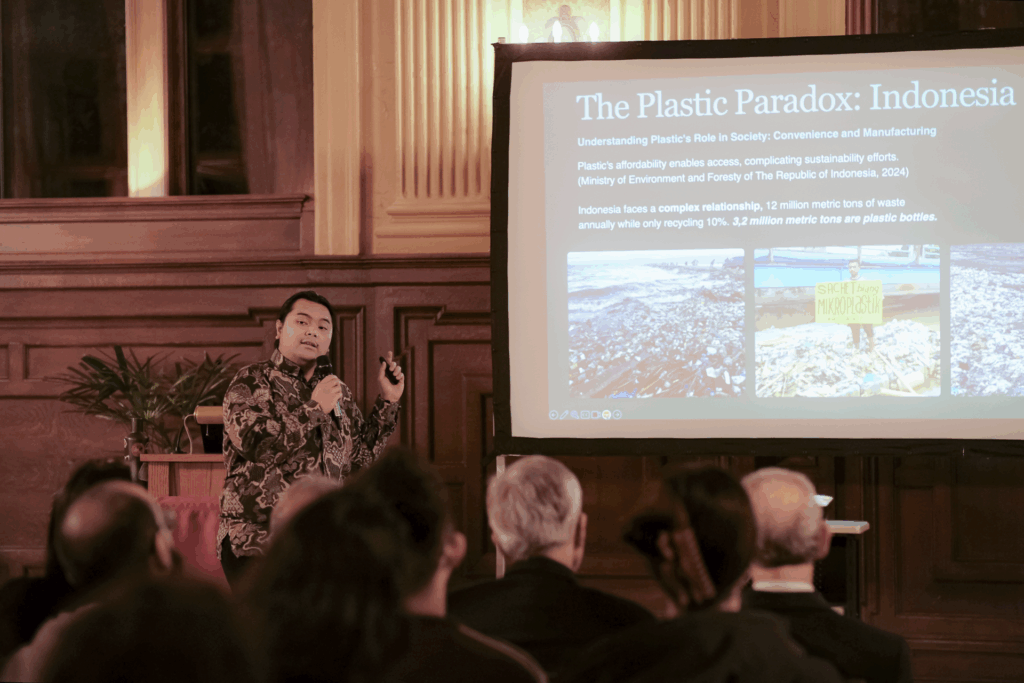
Every year, Indonesia produces over 12 million tons of plastic waste, and yet less than 10% is recycled effectively, according to the Ministry of Environment and Forestry. The images of clogged rivers and coastal trash have made plastic the face of environmental failure. But what if our understanding of sustainability has been oversimplified — even misguided?
In many developing countries, plastic is not just waste; it’s survival. It keeps food fresh, protects water from contamination, and provides affordable packaging for millions of small businesses. Replacing it with metal or ceramic alternatives often hailed as “greener” in global campaigns, comes at a much higher economic and energy cost. A 2020 study by the United Nations Environment Programme (UNEP) found that the carbon footprint of some reusable glass and aluminum packaging can exceed that of plastic if not reused hundreds of times.
This is the paradox of sustainability: what seems “green” on the surface can be far less sustainable in practice. The issue lies not in the material itself, but in how societies manage, innovate, and regulate its use. A “plastic ban” might sound noble in Paris, but in Jakarta or Manila, it can punish low-income consumers and stall local businesses without offering scalable alternatives.
The louder our green marketing becomes, the more we risk silencing nuance. Reusable cutlery made of bamboo or stainless steel looks good on paper but what matters more is lifecycle analysis, recycling infrastructure, and equitable access. The World Bank’s 2022 report on Circular Economy in Indonesia highlights that improving waste management systems could reduce plastic leakage by 70% without banning it altogether.
As young leaders, we must push sustainability beyond slogans. Policymakers need to understand not just the moral urgency but also the technical logic behind materials; why some plastics can be endlessly recycled, or why biopolymers fail without industrial composting facilities. Engineers and entrepreneurs must, in turn, design systems that make reuse and recovery economically viable.
True sustainability isn’t about rejecting plastic. It’s about creating habits and designing smarter systems that make every material, including plastic part of a circular economy. That’s the kind of leadership Indonesia needs: one that understands both the science beneath the slogans and the humanity behind the data.