Grace Mensah-Fosu is a rising Ghanaian literary creative, harnessing the power of words to inspire and empower. With a Bachelor of Arts from the University of Ghana and features in TSOO BOI and All Ghana A Stage anthologies, Grace is a dedicated writer, poet, and editor. Through her work with Hope4All Youth Program, she has mentored secondary school students, inculcating in them the need to pursue higher education. Grace believes every individual has a unique purpose and is driven to help others discover theirs.
In her free time, she finds wonder in the mundane, whether trying new dishes, reading a novel, taking a stroll, or talking to someone.
Scholar Voices
Global Leadership Vision Op-Ed | PsychoHairapy: Re-braiding strands of life through Community
By Grace Mensah-Fosu | November 2025
On May 18, 2023, the New York Times published an article titled “Black Men Don’t Do Therapy. Or so I thought,” which made me think a lot about Western conceptions of therapy and, more broadly, what it constitutes. What if, in addition to accessibility concerns, notions of Black people’s aversion to therapy stem primarily from a cultural mismatch between the Black community and westernized approaches to mental health treatment? Statistics seem to ignore the cultural significance of informal networks and human interdependence associated with hair braiding traditions that allow women to literally let down their hair.
Growing up, my best naps were taken in a barber’s chair. Something about sitting in that “hair chair,” the comfort of hands touching the scalp, and the refreshing breeze blowing on a newly exposed scalp after a neat haircut always had me loosening up and eventually sleeping off, long before the barber was finished with me.
The average Ghanaian girl makes an equal number of trips to the barbering shop as boys, trimming down her hair to a manageable length to ease the burden of rigorous, routine hair care practices associated with nurturing overgrown hair, such as washing, detangling, moisturizing and putting it into protective styles like twists, braids, locs, weaves, wigs or just chemically straightening. The art of braiding thus becomes a cultural legacy and a symbol of coming of age. It serves as a means of communicating one’s maturity and status in the community.
The value of hair in the daily lives and well-being of Black women is often underestimated. Hair texture, length, and styles often guide an overwhelming sense of negotiating self-image and self-worth, i.e., getting one’s hair done can lift one’s spirit and mood. According to Ashley and Brown (2015), “Hair care can provide a context and vehicle for attachment, nurturing and positive self-worth.” Although trips to the barbering shop eventually stop, we find similar experiences in the “hair chair” of the hairstylists, where in-depth conversations held during the braiding session create a special bond of sisterhood and nurturing. That “hair chair” seems almost equivalent to a therapist’s couch: a shared “safe space” built on mutual trust and vulnerability.
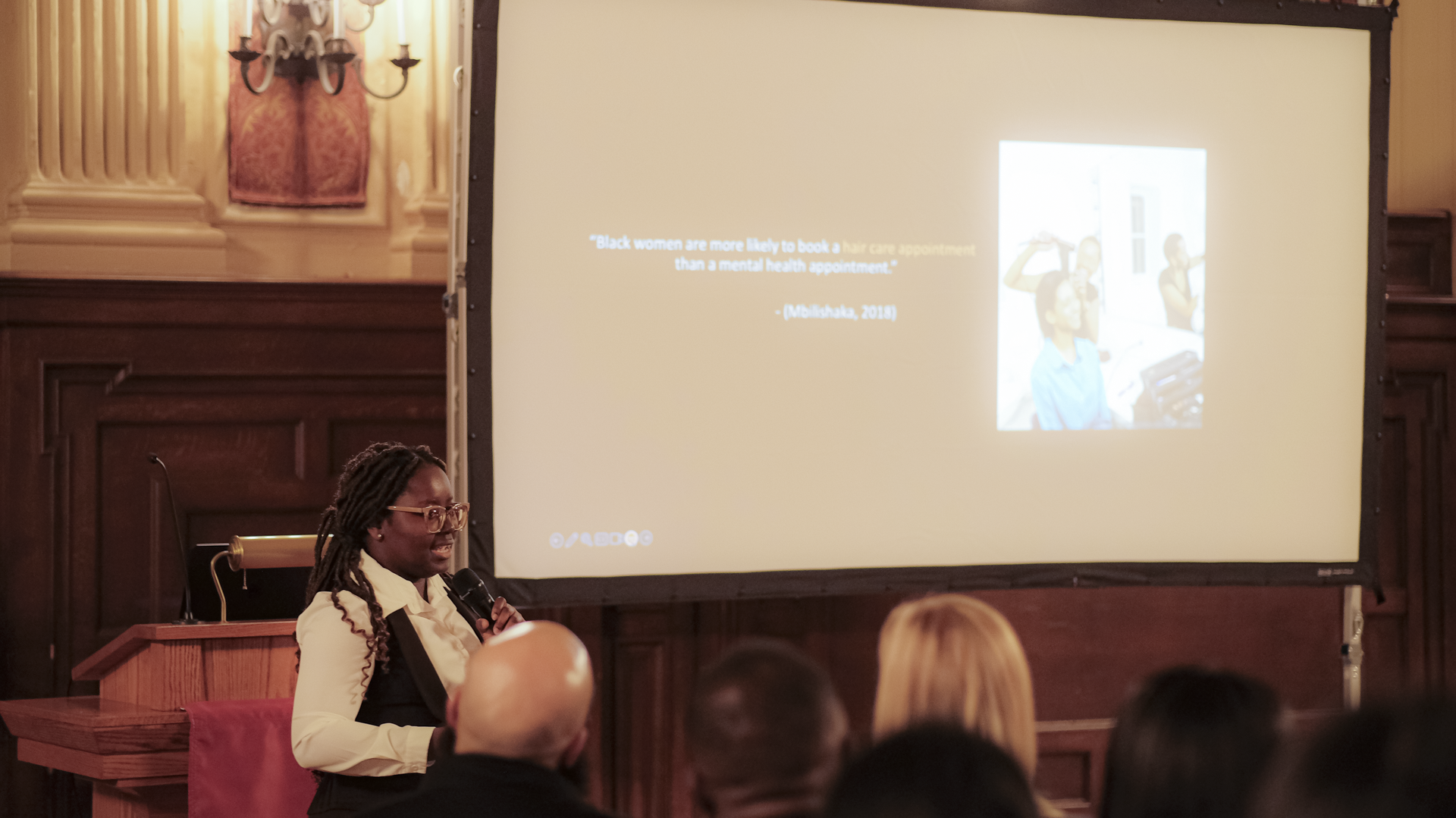
Hair care spaces can serve as community-based support systems; the bonds of sisterhood and nurturing embedded in hair-braiding settings redefine westernized conceptions of mental health and community. “PsychoHairapy,” proposed by Afiya Mbilishaka (2018), centers accessible therapy options in the safe space of the hair salon as an intervention. There already exists informal social support in the form of hairstylists and barbers; thus, in hoping to address the psychological needs in the Black community, psychologists must acknowledge and conduct efficacy studies that measure the possibility of collaborating with hairstylists to address the psychological needs in Black communities. Thus, combining mental health treatment modalities with cultural traditions can increase their impact.
It is true that many hairstylists may not be skilled enough to effectively cater to the psychological needs of others while effectively carrying out their duty. However, conducting educational workshops for hairstylists to incorporate counseling strategies and liaising with such spaces to make successful referrals for severe psychopathology would be a good start and a good way to remove stigma about receiving mental health services.